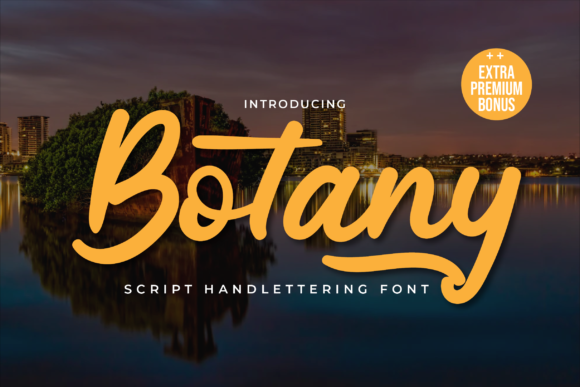
Botany: A Handwritten Font for Authentic Branding
There is a specific kind of visual fatigue that sets in when scrolling through the internet today. You see the same geometric sans-serifs and rigid corporate typefaces used over and over until they blend into a blur of digital noise. When you are trying to build a brand that feels approachable, organic, or distinctly human, those standard fonts often fall short. This is where a tool like Botany enters the conversation. It isn't just a set of letters; it is a flowing, stylish handwritten font that captures the authentic energy of a brush pen hitting paper.
For designers, entrepreneurs, and content creators, the challenge is rarely just "finding a pretty font." The real struggle is finding a typeface that bridges the gap between artistic expression and functional readability. Botany was created to solve that specific problem. It mimics the natural ink flow of hand-lettering, offering a personality that feels warm and crafted rather than manufactured. Because it is a Premium font that is PUA encoded, it offers a level of versatility that standard free fonts usually lack, allowing you to access every glyph and swash to customize your text perfectly.
The Personality of the Pen: Visual Style and Appeal
To understand the value of Botany, you have to look at the subtleties of its construction. It is a script font, but it leans more toward a modern calligraphic style than a traditional cursive. The strokes have a rhythmic quality—they thicken and thin based on the pressure of that imaginary brush pen. This gives the text a tactile quality, almost as if you could reach out and feel the wet ink on the page. It avoids the jagged, messy look of some grunge fonts while steering clear of the stiffness of digitized handwriting.
Visually, Botany strikes a balance that is difficult to achieve. It has enough flair to serve as a display font for headlines, yet it retains a clarity that makes it usable for shorter blocks of text. The letter connections are intuitive; they flow into one another in a way that the eye naturally follows. This creates a sense of movement on the page, which is essential for logo design and branding materials where you need to convey energy and forward momentum. It is a creative font that feels personal, making it an excellent choice for brands that want to put a human face on their digital presence.
Strategic Applications: Where Botany Fits Best
Choosing a typeface is a strategic decision, not just an aesthetic one. You need to consider where the font will live and how it will interact with your other design assets. Botany shines in environments where emotion and connection are prioritized. It is particularly effective in packaging design for artisanal goods, organic products, or boutique items where the packaging needs to communicate "handmade" quality before the customer even touches the product.
However, its utility extends far beyond physical goods. In the realm of web design and social media graphics, a handwritten font like Botany can break the monotony of standard web typography. It draws the eye immediately, making it perfect for call-to-action buttons, promotional banners, or Instagram quotes that need to stop a user mid-scroll. For editorial design, it works beautifully for pull quotes or section headers in magazines and blogs, adding a touch of elegance and breaking up long blocks of text.
Consider the needs of a lifestyle blogger or a small business owner. You want your brand identity to feel consistent across a website, a newsletter, and physical business cards. Botany allows for that consistency. You can use it for your main logo to establish a signature look, and then utilize it for specific headers in your email marketing to maintain that personal connection with your subscribers. It bridges the gap between digital and print media effectively, maintaining its charm whether it is rendered on a high-resolution screen or printed on textured cardstock.
Technical Utility: The Power of PUA Encoding
One of the most practical aspects of Botany is its technical backbone. For those who haven't dealt with font engineering, PUA (Private Use Areas) encoding might sound like jargon, but it is a game-changer for designers. Essentially, it means that all the extra stylistic elements—the swashes, ligatures, and alternate characters—are fully accessible even in programs that don't usually support advanced OpenType features.
Why does this matter? It means you aren't limited to the default look of the letters. If you are designing a wedding invitation or a hero image for a website, you can easily swap out a standard "t" for one with a sweeping tail, or connect an "o" and a "n" with a unique flourish. This level of customization allows you to create typography that looks truly bespoke. You can avoid the tell-tale repetition that marks a digital font, making your text look like genuine hand-lettering. This is vital for high-end logo design and bespoke branding projects where uniqueness is paramount.
Pairing and Professionalism: Making the Font Work for You
A common pitfall with expressive fonts is overuse. If you use Botany for every line of text on your website, you will likely hurt your readability and fatigue your audience. This is where the concept of font pairing comes into play. Botany needs a partner that grounds it. Because it is a high-personality script font, it pairs exceptionally well with clean, geometric sans-serifs or simple serifs.
Imagine a layout where the main headline is set in Botany—large, inviting, and organic. Beneath that, your body copy is set in a neutral sans serif font with generous line height. The contrast creates a clear visual hierarchy. The handwritten font grabs attention and sets the emotional tone, while the sans-serif delivers the information clearly. This pairing strategy ensures your design looks professional and polished rather than chaotic. It is a technique used constantly in modern editorial design to balance flair with function.
Furthermore, when selecting a commercial font like this, you are investing in reliability. Free fonts often come with incomplete character sets or licensing gray areas. A professional typeface ensures that you have the punctuation, numbers, and special characters needed for a complete design. It also ensures that you are legally covered for commercial use, which is a non-negotiable for serious business owners and agencies.
Evaluating Fit and Readability
Before committing to Botany for a major project, it is always wise to test the waters. Download the font and test it with your specific copy. Does the x-height work for your needs? Can you read it easily at smaller sizes? While modern typography embraces expressive typefaces, legibility should never be sacrificed entirely. Botany is designed to be legible, but as with any handwritten font, it is best suited for headlines, sub-headers, and short accent text rather than long-form body copy.
Think about your audience. If you are targeting a younger, trend-conscious demographic on social media, the stylish nature of Botany will likely resonate deeply. If you are creating a formal legal document, obviously, a serif font would be more appropriate. Context is everything. Use the font to enhance your message, not complicate it. By treating Botany as a strategic asset rather than just a decoration, you can elevate your design projects, create stronger emotional connections with your audience, and build a brand identity that feels genuinely human.